
Rejoignez getAbstract pour lire le résumé !

Do Nothing!

Rejoignez getAbstract pour lire le résumé !
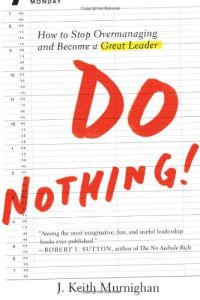
Do Nothing!

How to Stop Overmanaging and Become a Great Leader

Portfolio,

15 minutes de lecture
10 points à retenir
Texte disponible

Aperçu

To do your best as a manager, do nothing at all.


Editorial Rating

7

Qualities

  • Innovative

Recommendation

Does managing or leading others have to be a chore? Not if you don’t do it, says Northwestern University management professor J. Keith Murnighan. Imagine coming back from vacation or a day of meetings to find no office crises, no emergencies and no pressing issues. Murnighan’s chatty, smart management guide – which will be particularly effective for those who are leading small groups – can be a little repetitious and a bit cloying. Even so, getAbstract recommends his manual particularly for its brevity. Murnighan makes his point about light-handed management and then he goes home, where, presumably, he can contentedly do nothing.

Summary

Do Something by Doing Nothing

When most managers confront an office challenge, their typical reaction is to work harder. But “conscientious leaders do too much.” Even nonworkaholic leaders can feel that everything their subordinates are supposed to do is still their personal responsibility. This undermines the leaders’ performance and the employees’ work. Stop doing so much and create “chances to excel” for the members of your team. Don’t do. Lead.

New managers, in particular, are tempted to step back into their old, premanagement roles and do hands-on work instead of letting their subordinates accomplish the job. Determine the skills of your team members and let the most capable person for a task handle that task. That worker may not do the job exactly as you would, but a good performance will suffice. Stand back and let that performance unfold. Be a “facilitator and an orchestrator,” and allow your employees to carry out their responsibilities and do their work. Never micromanage. Let your people perform so they can feel proud of their accomplishments.

“Trust More”

Trust your team members. Nothing else will make your job as easy. Trust your employees...

About the Author

Corporate trainer and consultant J. Keith Murnighan is a professor at the Kellogg School of Management at Northwestern University in Evanston, IL.


Comment on this summary

More on this topic

Related Skills

Développer son intelligence émotionnelle
Apprendre à s'adapter
Communiquer efficacement
Rédiger un business plan
Develop Team Members
Création d’entreprise
Promouvoir une culture de l'innovation
Ressources Humaines
Innovation
Diriger de façon éthique
Bien vivre
Gérer le changement
Manage Learning and Development
Management
Développement personnel
Planifier et élaborer des stratégies de vente
Planifier stratégiquement
Promouvoir la diversité, l'équité et l'inclusion
Vente
Comprendre les organisations
Compétences professionnelles
Comprendre les approches de leadership
Gérer son temps
Practice Transformational Leadership
Communiquer de façon transparente
Direction exécutive
Manage People and Talent
Diriger stratégiquement
Comprendre la motivation
Communiquer sur la stratégie d'entreprise
Faire preuve d’authenticité
Navigate Leadership Challenges
Développer un état d'esprit de croissance
Définir l'objectif, la vision et la mission
Encourager l'appropriation chez les autres
Créer un sentiment d'appartenance
Leadership
Savoir coacher
Compétences relationnelles
Gérer l'impact de son leadership
Faire preuve d'humilité
Pratiquer le Servant Leadership
Communiquer stratégiquement
Gérer les équipes de vente
Motiver son équipe
Foster Team Culture
S’auto-diriger
Oser se montrer vulnérable
Drive Team Performance
Conduire le changement
Développer ses compétences interpersonnelles
Faire preuve d’empathie et de compassion
Construire une vision commune
Déléguer efficacement
Devenir plus productif
Définir les objectifs commerciaux
Se fixer des objectifs et les atteindre
Susciter la confiance
Renforcer la sécurité psychologique
Fixer des objectifs d'équipe