
Join getAbstract to access the summary!

The McKinsey Mind

Join getAbstract to access the summary!
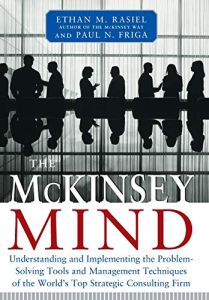
The McKinsey Mind

Understanding and Implementing the Problem-Solving Tools and Management Techniques of the World's Top Strategic Consulting Firm

McGraw-Hill,

15 min read
10 take-aways
Text available

What's inside?

If you can’t afford to hire McKinsey & Co., this is the book for you.


Editorial Rating

7

Qualities

  • Applicable

Recommendation

Throughout the 1990s, consultants were the kings of business and one firm, McKinsey & Co., reigned above all others. In The McKinsey Mind, Ethan M. Raisel and Paul N. Friga, former McKinsey & Co. consultants, describe the methods that the famed firm uses in improving the performance of its consultants. These techniques, which relate to problem solving, management and communications, combine to produce the equivalent of a basic MBA textbook. But unlike much of your grad-school reading, this one is right on target to address your real-life business executive. As such, getAbstract recommends this book not just for its McKinsey cachet, but for its applicable approaches to business.

Summary

Making Decisions the McKinsey Way

McKinsey & Co., founded in 1923, has become one of the world’s most successful strategic consulting firms.

It has 84 offices around the world and employs 7,000 professionals from 89 countries. It has consulted with over 1,000 clients, including 100 of the 150 largest companies in the world, and many state and federal agencies in the United States.

Many of is former consultants have become well known, including Tom Peters, author of In Search of Excellence, and less happily today, Jeffrey Skilling, former CEO of Enron.

McKinsey & Co. relies on a well-defined, fact-based method of problem solving and management. All new consultants go through a rigorous training program to learn the firm’s techniques. When a McKinsey team enters into an assignment, known internally as an engagement, it looks for the key drivers affecting the problem.

The process is based on a six-step model, which includes these elements, which you can apply in your own company:

  1. Identifying the Need. Isolate the core problem facing the client. Generally, business problems are based on competitive, organizational, financial or operational...

About the Authors

Ethan M. Rasiel  was a consultant in McKinsey & Co.’s New York office. Among his clients were major companies in finance, telecommunications, computing and consumer goods. Paul N. Friga worked for McKinsey in the Pittsburgh office. His projects related to international expansion, acquisition and strategic planning, education, water, and other industries. He is Acting Director at the North Carolina Knowledge Management Center at the University of North Carolina.


Comment on this summary

More on this topic

Related Skills

AI Transformation
Attract and Recruit Talent
Be Creative
Career
Communicate Effectively
Convert Prospects
Corporate Finances
Develop Team Members
Develop Your Thinking Skills
Drive Team Performance
Entrepreneurship
Human Resources
Innovate Strategically
Innovation
Lead Operational Planning
Lead Strategically
Leadership
Manage Learning and Development
Market Insights by Industry
Marketing
Master Interpersonal Skills
Navigate Leadership Challenges
Personal Growth
Plan and Strategize Your Sales
Sales
Search for a Job
Secure Funding
Strengthen Team Collaboration
Strengthen Your Digital Literacy
Understand Consumer Behavior
Understand Innovation
Understand Organizations
Workplace Skills
Conduct User Research
Master B2B Sales
Manage Change
Identify Prospects' Needs
Make Data-Driven Decisions
Understand Organizational Change
Understand Statistics
Foster Ownership in Others
Manage Team Communication
Think Strategically
Present Data
Craft a Personal Elevator Pitch
Lead Remote or Hybrid Teams
Think Scientifically
Ask Questions
Master Logical Reasoning
Soft Skills
Think Analytically
Leverage AI for Management
Drive Investments and M&A
Lead Yourself
Management
Conduct Candidate Interviews
Lead Mergers and Acquisitions
Manage Sales Teams
Master Systems Thinking
Present in Person
Think Critically
Manage Team Boundaries
Consulting Industry
Manage Teams and Departments
Innovate Business Models
Analyze Data
Consulting Challenges
Ace Job Interviews
Executive Leadership
Influence Others
Consulting Key Players
Facilitate Discussions
Persuade Effectively
Implement Executive Coaching
Make Good Decisions
Delegate Effectively
Challenge Assumptions
Communicate Corporate Strategy
Solve Problems
Drive Project Management
Write Winning Proposals
Consulting Case Studies
Manage People and Talent
Communicate Value
Consulting Best Practices
Pitch Your Business Idea
Present to Prospects